The Twin Cities School — The lab before D&D
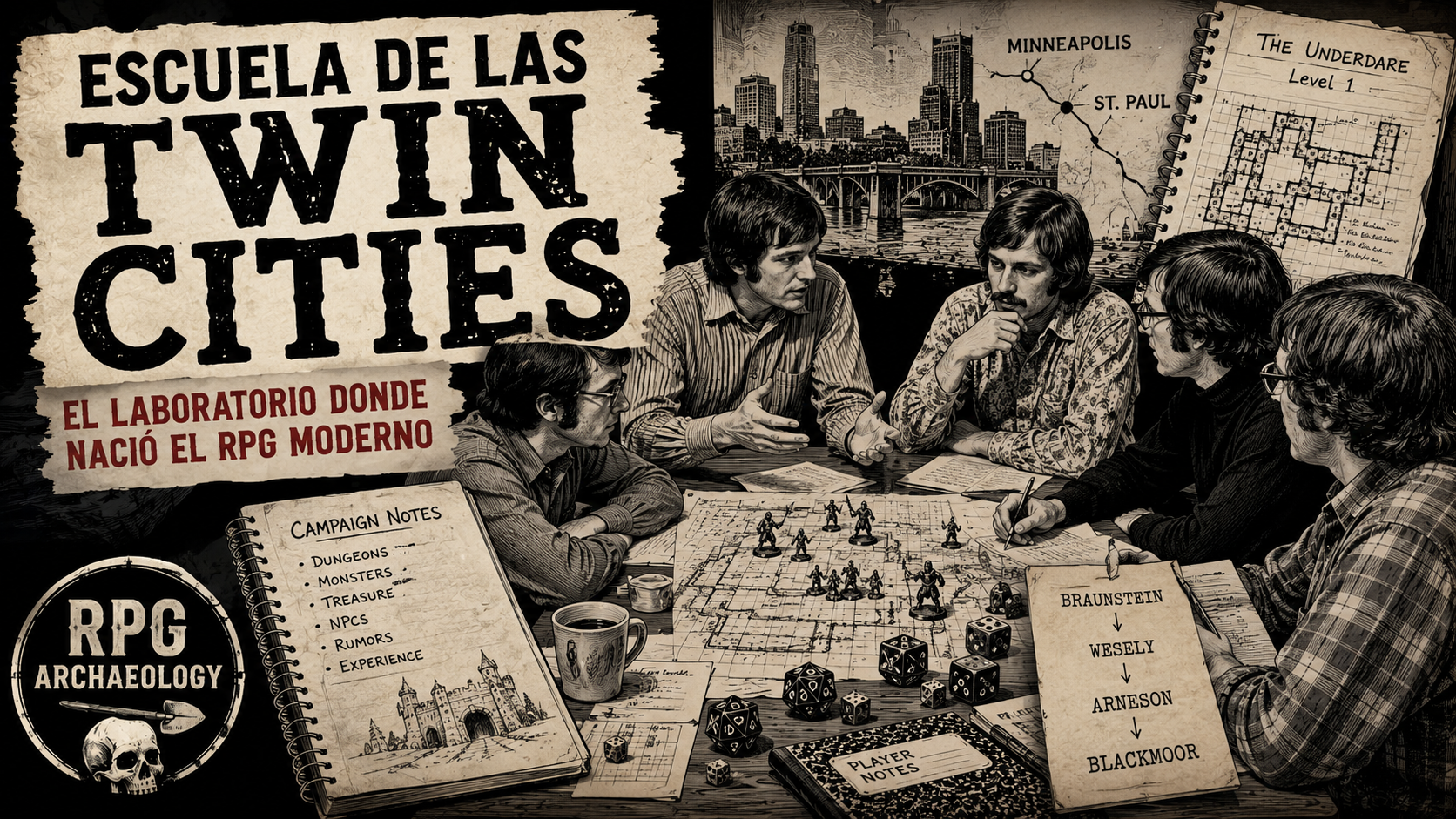
▶ Watch the episode on YouTube
1. Purpose of the research
The popular history of Dungeons & Dragons tends to condense around two names:
Dave Arneson and Gary Gygax.
The attribution is understandable: both are credited as co-creators of the game published in 1974.
However, going back a few years reveals a much more collective story.
Before Blackmoor, before Dungeons & Dragons, and before TSR, there was an active community of wargamers in the Minneapolis–St. Paul, Minnesota area.
Within it participated people like:
- David Wesely;
- Dave Arneson;
- David Megarry;
- Greg Svenson;
- John Snider;
- Richard Snider;
- Duane Jenkins;
- and other players and designers.
They did not form a "school" in the academic sense nor necessarily used that term to describe themselves.
In RPG Archaeology, we will provisionally use:
The Twin Cities School
as a label to study that ecosystem of players, referees, and designers who, through successive wargaming experiments, developed practices that would prove fundamental for the birth of the RPG.
The central question will be:
What happened in the Twin Cities for a group of wargamers to start playing in a way that no longer fit entirely within traditional wargaming?
2. A caution: do not look for a single inventor
A genealogy overly simplified could be written as:
WARGAMES
    ↓
ARNEson
    ↓
BLACKMOOR
    ↓
D&D
But this representation eliminates precisely the experimental environment that made Blackmoor possible.
Available historical evidence shows exchange of ideas between players, constant rule modification, and prior experiments that introduced elements that would later be recognizable in the RPG.
Therefore, this research proceeds from a different methodological hypothesis:
The RPG did not appear through a single punctual invention. It arose through accumulation, recombination, and stabilization of different gameplay practices.
This does not eliminate the individual importance of Arneson, Wesley, Gygax, or others.
It allows understanding what each one actually did.
3. The Twin Cities and wargaming
During the 1960s, an active community of war game enthusiasts existed in Minneapolis–St. Paul.
Like in other American communities of the period, its participants:
- played commercial wargames;
- designed variants;
- wrote their own rules;
- organized campaigns;
- exchanged ideas;
- participated in clubs;
- used correspondence and amateur publications.
The wargaming of that time should not be imagined only as consumers playing finished products.
An important part of the hobby was precisely modifying the game.
RULESET
    ↓
GAME SESSION
    ↓
PROBLEM / IDEA
    ↓
HOUSE RULE
    ↓
VARIANT
    ↓
NEW GAME SESSION
This culture of modification is fundamental to understanding what happens next.
4. David Wesely
One of the central figures in this environment was David Wesely.
Wesley was a wargamer and amateur designer, but he was also deeply interested in a problem that had accompanied wargaming since Kriegsspiel:
How can a referee resolve situations that the rules have not explicitly anticipated?
That problem led him toward adjudication systems and later to the development of Strategos.
5. Strategos and the referee tradition
The name Strategos has a prior genealogy.
In 1880, the American officer Charles A. L. Totten had published:
Strategos: A Series of American Games of War.
The work belonged to the American adaptation tradition of the European Kriegsspiel.
Decades later, Wesley recovered ideas related to this tradition of adjudicated games for his own experiments.
The important element for our genealogy is not a direct mechanical transmission of all its rules.
It is the survival of a figure:
the referee.
In traditional wargaming, the referee could:
- maintain hidden information;
- know the complete state of the situation;
- receive orders from players;
- interpret rules;
- resolve ambiguous situations;
- communicate only the information available to each participant.
We can represent this model:
PLAYER A ──┐
             │
             ▼
          REFEREE
             ▲
             │
PLAYER B ──┘
             │
             ▼
          REAL STATE
          OF THE SCENARIO
This mechanism will be crucial for what happens next.

## 6. Braunstein

In 1969, David Wesley organized an experimental game that would later be known as *Braunstein*.

The scenario represented a fictional German city during a Napoleonic military context.

The experiment began as a variation on traditional war games.

But Wesley introduced a decisive modification.

Instead of limiting all participants to controlling military forces, different participants received individual roles within the city.

They could represent, for example:

- officers;
- local authorities;
- bankers;
- students;
- revolutionaries;
- characters with their own interests.

Each participant could possess:

- different information;
- personal objectives;
- different relationships with others;
- possibilities of action not fully anticipated by the rules.

The center of the game began to shift.

It was no longer only:

> What orders do you give to your forces?

Now it could be:

> What does your character do?

## 7. The productive accident

One of the most important features of *Braunstein* is that much of what would later be interesting was not necessarily planned as the birth of a new genre.

Participants began to:

- negotiate;
- deceive each other;
- conspire;
- separate;
- pursue personal objectives;
- perform actions that Wesley had not anticipated.

This produced a situation apparently problematic.

The available rules could not describe all possible actions.

But Wesley had a tool from adjudicated wargaming:

the referee.

When a player declared an unanticipated action, Wesley could decide what happened.

```text
PLAYER
   │
   │ "I want to do X"
   ▼
REFEREE
   │
   │ interprets situation
   │ applies rules if they exist
   │ adjudicates if they don't
   ▼
WORLD RESPONDS
Here appears one of the fundamental principles of the tabletop RPG:
The space of possible actions can be greater than the space of written rules.
The referee covers the difference.
8. From unit control to individual role
The change seems small:
BEFORE


Player
   ↓
Army / unit

versus:

BRAUNSTEIN


``text
Player
   ↓
Individual
But its consequences are enormous.
When the player controls an individual, issues that may be secondary in a traditional wargame begin to matter:
- identity;
- motivations;
- personal information;
- relationships;
- concrete positioning;
- survival;
- individual decisions.
The participant stops observing the battle exclusively from above.
They begin to inhabit the situation from within.
We don't yet necessarily have a complete RPG.
But one of its fundamental perspective shifts is already present.
9. Braunstein was not yet Dungeons & Dragons
We should avoid interpreting Braunstein retrospectively as if Wesley had organized a modern RPG session.
DOCUMENTED FACT
Braunstein introduced individual roles, differentiated objectives, incomplete information, and referee adjudication.
HISTORICAL INFERENCE
These characteristics constitute clear antecedents of practices later central to role-playing games.
CAUTION
This does not mean Braunstein already contained all the elements that would later define the RPG:
- persistent campaign;
- persistent character developed through numerous sessions;
- systematic progression;
- dungeon crawl;
- classes;
- levels;
- experience system;
- modern adventurer party structure.
It is precisely the subsequent evolution that interests us.
10. The experiment continues
The success —or productive chaos— of Braunstein led to new sessions and variants.
Other participants began experimenting with the format.
This is important because it changes our genealogy.
We don't have:
Wesley
   ↓
invents system
   ↓
Arneson copies it
We have something more like:
WESELY
   │
   ▼
BRAUNSTEIN
   │
   ▼
PLAYERS
   │
   ├── prueban
   ├── modifican
   ├── reinterpretan
   └── crean variantes
        │
        ▼
    NUEVOS EXPERIMENTOS
Innovation began to circulate within the group.
11. Dave Arneson steps onto the scene
Dave Arneson belonged to this community and participated in Wesley's experiments.
Later he began to develop his own games.
In April 1971 there is contemporary documentation that Arneson was preparing what he described as a:
"medieval Braunstein"
The expression is extraordinarily important.
It provides us with a documentary link between:
BRAUNSTEIN
     ↓
MEDIEVAL BRAUNSTEIN
     ↓
BLACKMOOR
We don't need to reconstruct retrospectively the entire relationship.
The participants themselves were using Braunstein's vocabulary to describe the new experiment.
12. Blackmoor
Arneson's experiment ended up becoming Blackmoor.
Here, several ideas that had appeared earlier began to combine within a more stable structure.
Blackmoor progressively incorporated:
- individual characters;
- continuity between sessions;
- persistent world;
- exploration;
- combat;
- treasures;
- progression;
- adventures;
- factions;
- referee;
- rules modified and added during play.
The fundamental change relative to Braunstein could be summarized as:
BRAUNSTEIN


situation
   ↓
individual character
   ↓
objective
   ↓
resolution

versus:

BLACKMOOR


individual character
      ↓
adventure
      ↓
survives
      ↓
preserves state
      ↓
progresses
      ↓
returns
      ↓
new adventure
      ↓
same world
Persistence appeared.
And with it, the nature of the game changed deeply.
13. Blackmoor as crystallization
Here we must be especially precise.
Saying:
"Dave Arneson invented the RPG."
is an overly strong statement for the state of our research.
But saying:
"Blackmoor constitutes one of the first campaigns where numerous fundamental elements of the RPG appear combined in a persistent and recognizable way."
is much more defensible.
Later testimonies from Twin Cities participants attribute to Arneson a central role in that crystallization.
An important reason is that Arneson carried the experiment toward a continued campaign and left documentation about it.
That's why Blackmoor occupies a different position from the previous Braunstein.
Not necessarily because each element was invented there.
But because there many of them began to work together.
14. David Megarry
Another fundamental participant was David Megarry.
Megarry played in Blackmoor as H. W. Dumbo and participated in dungeon expeditions.
His experience produced later another historically important artifact:
Dungeon!
The board game reduced part of the dungeon crawl experience to a much more formalized structure:
DUNGEON
   ↓
habitaciones
   ↓
monstruos
   ↓
combate
   ↓
tesoro
   ↓
progresión por el espacio
This is fascinating for RPG Archaeology.
Blackmoor was generating different descendants.
One would end up contributing to D&D.
Another could abstract the dungeon crawl toward a board game.
The same experience was being interpreted from different perspectives.
15. Megarry's maps
Megarry also preserved maps made during his Blackmoor explorations.
These documents constitute one of our most interesting sources.
They don't simply represent a dungeon designed afterward.
They represent the spatial perception of a player during an early campaign before D&D was published.
Megarry later explained to Boggs that players:
- didn't see Arneson's map;
- received descriptions;
- heard distances;
- received room dimensions;
- knew exits and stairs through description;
- drew their own sketches on graph paper.
Therefore:
ARNEson'S MAP
      ↓
DESCRIPTION
      ↓
PERCEPTION
      ↓
SKETCH
      ↓
MEGARRY'S MAP
16. Greg Svenson and Tonisborg
Greg Svenson, another participant in the Twin Cities environment and early Blackmoor player, developed his own dungeon:
Tonisborg.
Its importance for our genealogy is considerable.
Tonisborg demonstrates that the dungeon was not limited to:
"the thing that Dave Arneson runs."
Other participants began to build and run their own adventure spaces.
This implies a transfer of knowledge.
ARNEson
   ↓
BLACKMOOR
   ↓
PLAYERS
   ↓
comprenden el formato
   ↓
CREAN SUS PROPIOS DUNGEONS
When a practice can be reproduced by others, we are dealing with something much more important than a personal peculiarity of the original referee.
We are witnessing the emergence of a transmittable form of play.
17. The referee as technology
One of the most interesting discoveries of our entire genealogy is the continuity of the referee figure.
We can trace approximately this line:
KRIEGSSPIEL
     │
     ▼
UMPIRE
interprets military situation
     │
     ▼
FREE KRIEGSSPIEL
judgment > exhaustive rule
     │
     ▼
WESELY
BRAUNSTEIN
     │
     ▼
REFEREE
resolves individual actions
     │
     ▼
ARNEson
BLACKMOOR
     │
     ▼
REFEREE
mantiene mundo persistente
This doesn't mean there is a perfect linear transmission between each element.
But a conceptual continuity does appear:
a human situated between the rules and the world can interpret actions that the system hasn't fully formalized.
This capability will be fundamental for the RPG.
18. Freedom appears before the rules
In a completely closed game:
POSSIBLE ACTIONS
      =
RULEED ACTIONS
In the Twin Cities experiments, something different begins to appear:
POSSIBLE ACTIONS
      >
RULEED ACTIONS
The player can try something that no one wrote beforehand.
The referee decides how to respond.
This simple inequality may be one of the most important conceptual transformations of the entire RPG genealogy.
It allows the player to stop selecting only options available within the system.
They can begin to declare intentions.
19. Designing through play
Another common pattern seems to be the absence of a rigid separation between:
DESIGN
  ↓
FINISHED PRODUCT
  ↓
PLAYTEST
Practice seems much more iterative:
IDEA
  ↓
GAME SESSION
  ↓
UNEXPECTED SITUATION
  ↓
ADJUDICATION
  ↓
NEW RULE
  ↓
NEXT SESSION
In other words:
the game was being discovered while being played.
This characteristic will be especially visible in Blackmoor.
20. An oral culture
There is also an important historiographic problem.
Much of these innovations did not initially appear in commercial manuals.
They circulated through:
- game sessions;
- conversations;
- correspondence;
- clubs;
- fanzines;
- private notes;
- typed rules;
- demonstrations.
This explains why reconstructing the genealogy is so difficult.
An idea could exist for months before being documented.
Another could be used by several participants without us knowing exactly who introduced it first.
And decades later, protagonists' memories might differ.
Therefore, we must always distinguish:
first known documented evidence
from
first actual use.
They are not necessarily the same.
21. Secrets of Blackmoor
The Secrets of Blackmoor documentary is a particularly interesting source for reconstructing this environment.
Secrets of Blackmoor — sitio oficial
Its main value for RPG Archaeology lies in gathering later testimonies from numerous participants linked to the original Blackmoor scene and the Twin Cities.
Among them appear memories about:
- Braunstein;
- Wesley;
- Arneson;
- Blackmoor;
- early campaigns;
- referee methods;
- rule evolution;
- Twin Cities player culture.
SOURCE CLASSIFICATION
It should be treated mainly as:
POSTERIOR TESTIMONY OF PARTICIPANTS
and not as contemporary documentation of 1969–1971.
This doesn't reduce its enormous value.
It simply requires that specific claims be contrasted with:
- contemporary documents;
- fanzines;
- maps;
- manuscripts;
- correspondence;
- early publications.
22. A collective innovation
After studying this ecosystem, it becomes difficult to maintain a purely individual genealogy.
A more adequate representation would be:
                   WARGAMING
                       │
                       ▼
                TWIN CITIES SCENE
                       │
            ┌──────────┬──────────┐
            │                     │
            ▼                     ▼
       WESLEY                OTHERS
            │              EXPERIMENTS
            ▼                     │
       BRAUNSTEIN                │
            │                     │
            └──────────┬──────────┘
                       ▼
                    ARNESON
                       │
                       ▼
                   BLACKMOOR
                       │
          ┌────────────┼────────────┐
          │            │            │
          ▼            ▼            ▼
       MEGARRY      SVENSON      OTHERS
       Dungeon!     Tonisborg   experiments
Blackmoor occupies the center because it ended up being the historically decisive branch for D&D.
But its roots belong to an ecosystem.
23. And meanwhile, in Lake Geneva...
The story is not yet complete.
While the Twin Cities experimented with characters, referees, and campaigns, another wargaming community was developing different systems.
In Wisconsin, Jeff Perren and Gary Gygax had worked on medieval rules that would be published in 1971 as:
Chainmail.
Its evolution followed another path:
WARGAMING
    ↓
MEDIEVAL COMBAT
    ↓
FORMALIZED RULES
    ↓
FANTASY SUPPLEMENT
    ↓
HEROES / WIZARDS / MONSTERS
So we have two contemporary lines:
TWIN CITIES                     LAKE GENEVA

Wesley                           Perren
   │                               │
Braunstein                        │
   │                               ▼
Arneson                       Perren + Gygax
   │                               │
Blackmoor                      Chainmail
   │                               │
   │                               │
   └───────────────┐ ┌─────────────┘
                   ▼ ▼
                    ?
That question mark will eventually be called:
Dungeons & Dragons.
24. They were not two isolated worlds
Nor should we interpret Twin Cities and Lake Geneva as two completely independent laboratories.
American wargaming communities were connected through:
- associations;
- conventions;
- correspondence;
- fanzines;
- publications;
- shared campaigns.
Dave Arneson belonged to the Castle & Crusade Society, organization founded by Gary Gygax and Robert Kuntz.
There was, therefore, circulation between both environments before D&D existed.
The real genealogy resembles more a network than a tree.
25. From experimental community to product
Here appears a transition that must be studied in the document dedicated to D&D.
The Twin Cities culture worked extraordinarily well to generate new forms of play.
But a home campaign could depend enormously on implicit knowledge.
Blackmoor could work because:
Dave Arneson was there.
A commercial product needed to solve another problem:
How can someone who never met Arneson reproduce a similar experience?
That required turning part of the oral knowledge into:
- rules;
- procedures;
- tables;
- examples;
- terminology;
- documentation.
Here will begin to matter especially the convergence with Gary Gygax and his experience writing and publishing rules.
26. The authorship question
This genealogy also requires careful use of the word "inventor."
We can identify important contributions:
David Wesley
Braunstein and the use of individual characters with their own objectives within an adjudicated scenario.
Dave Arneson
The transformation and consolidation of those practices within a persistent fantasy campaign that would become Blackmoor.
David Megarry
Participation in Blackmoor, early cartography, and later abstraction of the dungeon crawl in Dungeon!.
Greg Svenson
Early participation and reproduction of the format through Tonisborg.
Gary Gygax and Jeff Perren
Parallel development of Chainmail, providing another important vocabulary of medieval and fantasy rules.
But no list fully captures the process.
Innovation circulated.
27. Did Arneson invent the RPG?
After this research, we can respond with greater precision.
TOO STRONG FORMULATION
Dave Arneson alone invented the role-playing game.
TOO WEAK FORMULATION
Arneson simply added fantasy to wargames.
PROVISIONAL FORMULATION
Dave Arneson was the central figure in the consolidation of Blackmoor, one of the first campaigns known where different innovations from wargaming and Braunstein experiments combined in a persistent and recognizable form that was a direct antecedent of the modern RPG.
His importance does not require erasing Wesley or the others.
On the contrary.
Understanding the ecosystem allows appreciating better what concrete transformation Arneson actually performed.
28. Why Blackmoor and not Braunstein?
This is probably one of the fundamental questions.
Braunstein had introduced a decisive rupture:
the individual within the scenario.
Blackmoor seems to have added something equally important:
the individual continues to exist after the scenario.
That change introduces:
CHARACTER
   +
PERSISTENCE
   +
WORLD
   +
PROGRESSION
   +
REFEREE
=
CAMPAIGN
When a session ends, the game doesn't necessarily reset to zero.
The character has history.
The world has memory.
And both can change.
There, we clearly begin to recognize the RPG.
29. Archaeological synthesis
The provisional conclusion of RPG Archaeology would be:
The Twin Cities School was not a formal school, but an ecosystem of experimental wargamers in which different players began to expand the possibility space beyond traditional rules.
David Wesley and Braunstein demonstrated that a participant could control an individual with their own objectives within an adjudicated scenario.
Dave Arneson turned part of that tradition into Blackmoor, where characters and world gained persistence.
Blackmoor players were not passive consumers.
They mapped, experimented, designed, and reproduced the new format.
David Megarry developed Dungeon!.
Greg Svenson developed Tonisborg.
Other participants contributed ideas, characters, rules, and experiences.
Therefore:
Blackmoor did not appear in a vacuum. It was the most influential crystallization of a collective laboratory.
30. The next layer
Our genealogy is now:
KRIEGSSPIEL
    │
    ▼
FREE KRIEGSSPIEL
    │
    ▼
RECREATIONAL WARGAMING
    │
    ▼
AMERICAN WARGAMING COMMUNITY
    │
    ├───────────────────────┐
    │                       │
    ▼                       ▼
TWIN CITIES              LAKE GENEVA
    │                       │
 WESLEY                    PERREN
    │                       │
 BRAUNSTEIN                 ▼
    │                 PERREN + GYGAX
    │                       │
    ▼                   CHAINMAIL
ARNEson                    │
    │                       │
    └──────────┬────────────┘
               ▼
      ARNESON + GYGAX
               │
               ▼
       DUNGEONS & DRAGONS
             1974
This will be the starting point of the next document:
Dungeons & Dragons — Arneson and Gygax: the history of D&D
There we will stop studying the laboratories separately.
We will study what happened when they converged.
31. Open questions
This first excavation leaves several issues for future research:
- What exact rules did the first Braunstein use?
- How did they evolve between Wesley's game sessions?
- What elements did Arneson adopt directly?
- Which ones did he modify?
- What innovations emerged specifically during Blackmoor?
- What contributions can be documented from other Twin Cities players?
- How far does Tonisborg reproduce Blackmoor procedures?
- What exact relationship exists between Megarry's experience in Blackmoor and Dungeon!?
- What contemporary documentation about the first sessions remains accessible?
- When did systematic character persistence begin exactly?
- When did mechanical progression appear?
- How were originally resolved movement, time, and exploration?
- What ideas traveled from Twin Cities to Lake Geneva before the Blackmoor demonstration?
- What elements that we later attribute to D&D were already circulating collectively among wargamers?
32. Initial sources and classification
Participant testimonies
Secrets of Blackmoor — official site
Documentary built around later testimonies from participants in the original Blackmoor scene and the Twin Cities.
It should be used as retrospective oral source, cross-referencing specific claims whenever contemporary documentation is available.
Research on Blackmoor and cartography
Hidden in Shadows — Daniel H. Boggs
Especially useful for early documentation, maps, David Megarry testimonies, and historical reconstruction of Blackmoor.
Secondary source in Spanish
Red de Rol — The lost link between wargames and tabletop RPGs
Useful as an introduction and source of clues. Important historiographic claims should be contrasted with primary sources or specialized research.
Methodological note
"The Twin Cities School" is a designation used by RPG Archaeology to organize this research.
It does not pretend to assert that Wesley, Arneson, Megarry, Svenson, and the rest of the participants considered themselves members of a formal school.
The label describes an observable phenomenon:
a localized, connected, and experimental community in which different practices from wargaming evolved through play, adjudication, and exchange until producing some of the fundamental structures of the RPG.
And perhaps that is the main lesson of this excavation.
Before Dungeons & Dragons existed, there were people discovering how to play it without yet knowing that what they were doing needed a name.