The Dark Heart of Uukrul — Technical Autopsy Report
Eriosthé, Map Formats, Transitions, Saves, and Integrity Mechanism
Project: RPG Archaeology
Provisional Close Date: 23-08-2026
Status: Research provisionally closed with several confirmed subsystems and a final validation mechanism pending exact resolution.
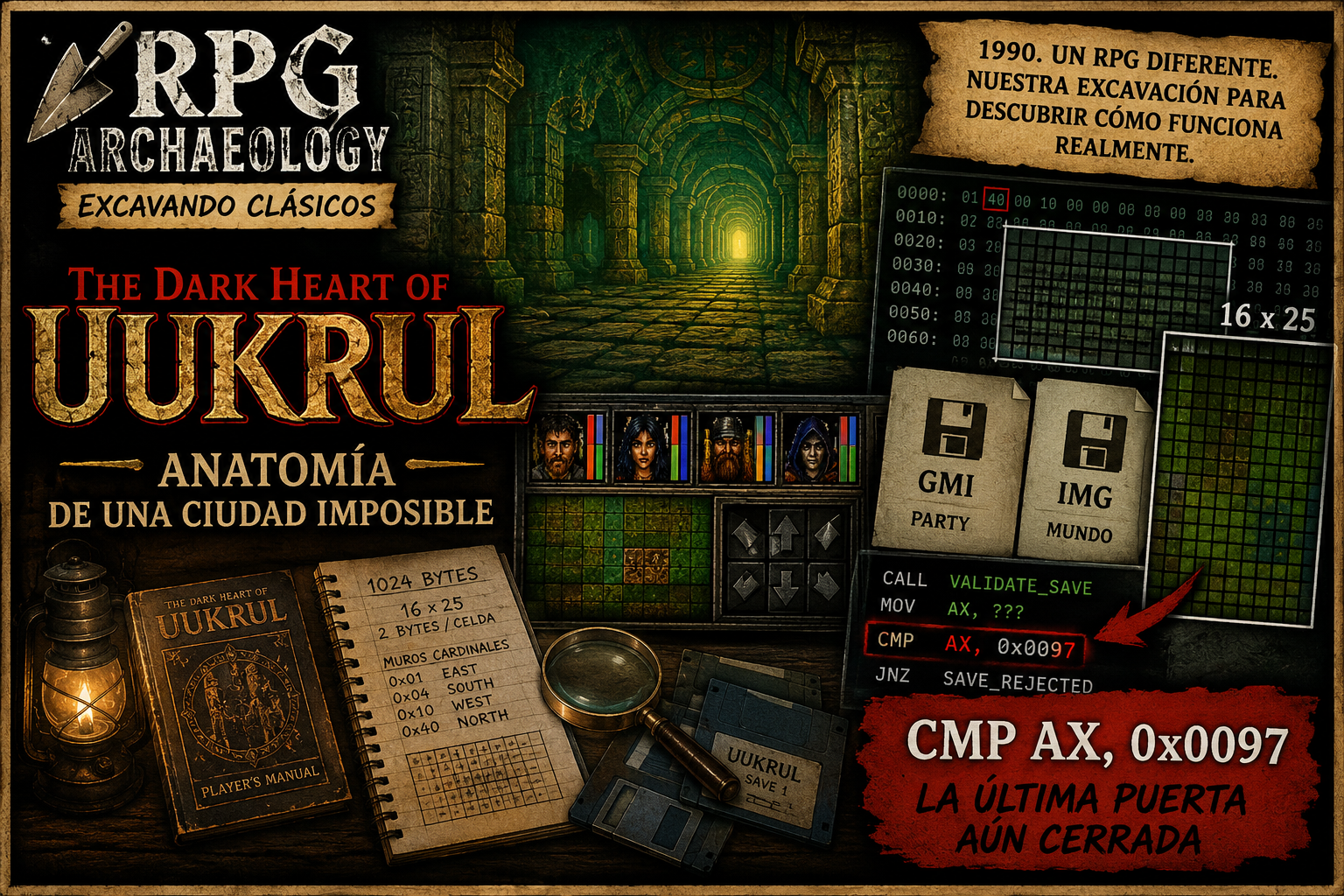
▶ Watch the episode on YouTube
1. Executive Summary
The investigation began with a relatively modest question: Can we reconstruct the maps of Eriosthé from The Dark Heart of Uukrul's original data?
The answer is yes.
From the MZ*.LEV files, executable, UUKRUL.LIB, UUKRUL.OVR, auxiliary tables, controlled saves, and debugging sessions in DOSBox-X, it was reconstructed with high accuracy:
- physical format of levels;
- exact wall topology;
- runtime representation of position and orientation;
- separation between group state (
.GMI) and world snapshot (.IMG); - part of the teleport/transitions architecture;
- a safe save parsing/editing tool;
- and the existence of a real integrity/anti-tamper mechanism that rejects seemingly valid modifications.
What was not fully achieved:
- complete enumeration of all MZ→MZ transitions;
- full semantics of event bytecode in
.LEVfiles; - nor the final algorithm causing modified saves to be rejected.
The investigation did locate the final stretch of that validator and instrumented the executable to observe the returned value at runtime.
2. Autopsy Philosophy
The operational rule was to always distinguish between:
- CONFIRMED — demonstrated by code, data, or runtime;
- STRONG — well-supported inference;
- SPECULATIVE — useful hypothesis not yet closed;
- UNKNOWN — unresolved;
- RETRACTED — previous interpretation corrected by new evidence.
This criterion proved especially important as several early hypotheses were discarded later. The research shouldn't be read as a linear chain of perfect discoveries, but as a succession of hypotheses, tests, corrections, and cuts.
PART I — ERIOSTHɶ
3. Format of MZ*.LEV Files
The studied levels use exactly 1024-byte .LEV files.
Reconstructed structure:
| Offset | Size | Meaning | Confidence |
|---|---|---|---|
0x000 |
0x320 |
geometry | CONFIRMED |
0x320 |
0xE0 |
events/script block | STRONG |
| total | 0x400 |
complete file | CONFIRMED |
Geometry occupies:
- 25 rows;
- 16 columns;
- 2 bytes per cell.
Access formula:
cell = DS:0x3816 + Y*0x20 + X*2
with:
Y = 0..24
X = 0..15
The loader copies the complete file into the runtime level buffer.
4. Bit-Exact Wall Topology
The lower byte of each cell contains the four cardinal walls:
0x01 = EAST
0x04 = SOUTH
0x10 = WEST
0x40 = NORTH
Semantics:
bit set = wall / blocked
The remaining four bits of the lower byte:
0x02
0x08
0x20
0x80
are special flags whose full semantics remain unresolved.
The high byte functions as additional type/feature, also preserved as unknown when sufficient evidence didn't exist.
The cardinal assignment was sustained through independent signals:
- redundancy between opposite sides of neighboring cells;
- statistical symmetry;
- global connectivity;
- correspondence with movement/LOS code.
Runtime uses directions:
dir0 = +X = EAST
dir1 = +Y = SOUTH
dir2 = -X = WEST
dir3 = -Y = NORTH
5. Spatial Philosophy of the Engine
There's no evidence of independent N/S and E/W edge arrays.
Topology is encoded per cell.
Movement and LOS query the directional state of a cell via engine helpers. Non-zero result equals blocked direction.
This produces a very compact representation:
2 bytes/cell
→ connectivity
→ type/feature
→ special flags
An interesting design conclusion: maps are small in absolute dimensions, but each cell can contain substantial playable information.
6. Event Block of LEV Files
The last 224 bytes show structured behavior and don't appear to be padding.
Tokens observed recurring:
01 00
3E 00
81 B8 66
The strongest interpretation:
0x320..0x3FF = compact event/command stream per level
The exact semantics of all opcodes remained open.
7. MZREG2
MZREG2.LEV appears in program tables/names but the file wasn't found in the game data used during research.
This points to a pre-planned and unshipped slot or withdrawn/incomplete content.
Automatic inference of what that level would have contained shouldn't be made.
PART II — TRANSITIONS AND TELEPORTS
8. TPORTS.TBL
TPORTS.TBL showed recognizable internal structure.
Four-byte records were identified with high regularity, and zone groups were found with labels like:
A B C D
X Y Z
1 2 3 4 5
! * ?
Records form topological relationships between zones and coordinates, but complete binding:
source MZ → port → destination MZ/X/Y
was not closed statically.
9. Confirmed Teleport Chain
The general mechanics could be reconstructed though:
event / port
→ selection via [0x3C1E]
→ 12-character row
→ destination decoding
→ dstX
→ dstY
→ dstLevel
→ SetLevel
→ load of new MZ
A SetLevel callable at runtime was also located via a far call, which established a reliable breakpoint during testing.
The final obstacle was locating the exact corpus of 12-character teleport rows generated/queried via resident/overlay helpers.
10. World Graph Result
Transition architecture was demonstrated.
The complete enumeration of direct MZ→MZ edges remained PARTIAL.
Therefore, any final graph must distinguish:
- confirmed nodes;
- zone relationships;
- directly demonstrated edges;
- still-inferred edges.
PART III — SAVE ARCHITECTURE
11. Two Files, Two Responsibilities
Research with controlled saves showed a clear separation.
GMI
Contains primarily structured group state.
Findings:
party base = 0x80
stride = 0x60
4 records
Fields identified:
status
current_hp
max_hp
name
inventory_count
inventory_raw
The parser built preserves unknown bytes.
IMG
Contains runtime/world snapshot state.
Mapping confirmed during experiments:
IMG +0x0A → Y
IMG +0x0C → X
IMG +0x0E → LEVEL
IMG +0x14 → FACING
Demonstrated with controlled saves:
- A = base state;
- B = turn;
- C = movement.
The .GMI files remained byte-identical while .IMG reflected movement/orientation.
12. CONTROL_A / B / C
Controlled experiments were decisive.
Turn
CONTROL_A_BASE → CONTROL_B_TURN
Changes observed in IMG:
0x14   FACING
0x24E  irregular state
Movement
CONTROL_A_BASE → CONTROL_C_MOVE
Changes observed:
0x0A   Y
0x14   FACING
0x24E  irregular state
0x655  map/step state still unresolved
The word at 0x24E changes with legitimate actions and ceased being considered a simple checksum.
Final prudent interpretation:
0x24E = RNG/action/runtime state
Not demonstrated as the integrity mechanism.
PART IV — SAVE ARCHAEOLOGY TOOL
13. Phase I — Core Headless
A safe parsing/editing tool was built.
Capabilities:
GMI
Editable:
name
status
current_hp
max_hp
IMG
Readable:
level
x
y
facing
Unknown bytes preserved.
No-op roundtrip:
GMI: byte-identical
IMG: byte-identical
Tool uses copy-on-write and avoids overwriting original.
14. Phase II — World Editing
Experimental support added for:
LEVEL
X
Y
FACING
Tests verified that isolated changes only modified expected bytes while keeping the rest of the file intact.
A lab was generated with:
FACING 0 → 1
Tests passed.
At binary level, the save seemed perfectly coherent.
At runtime, Uukrul rejected it.
PART V — THE ANTI-TAMPER DISCOVERY
15. Runtime Experiment
Two independent manipulations were tested.
A — GMI
Change:
HP 42 → 40
A perfectly playable state.
Result:
save rejected
B — IMG
Change:
FACING 0 → 1
Also a perfectly valid state.
Result:
save rejected
The game showed a message equivalent to:
The game saved on this disk is faulty. Use another saved game or another disk.
The exact runtime phrase related to tampering didn't appear as a complete literal in the binaries investigated; the locally found EXE message variant was "faulty".
Strong conclusion:
Uukrul validates something beyond the plausibility of edited fields.
There's an additional consistency/integrity invariant.
16. What Was NOT Demonstrated
It was not proven that the mechanism is:
- DRM;
- deliberate anti-cheat;
- a conventional checksum;
- a simple sum/XOR;
- or exclusively disk corruption protection.
The recommended terminology is:
save-integrity / anti-tamper mechanism
The interpretation of deliberate anti-cheat is plausible but requires more evidence on intent and algorithm.
PART VI — LOADER VALIDATION
17. Load Route Located
Static research located the load function and a validation segment.
The relevant pattern reduced to:
save loader
→ validation/dispatch
→ dynamic handler
→ return in AX
→ CMP AX, 0x0097
→ subsequent branch
A particularly relevant piece:
ljmp cs:[0x05DE]
The destination of cs:[0x05DE] is configured at runtime via a pointer chain linked to low memory.
This explains much of the difficulty of purely static analysis.
18. Important Correction: XOR AH,AH
Many times during research the pattern appeared:
30 E4
Initially interpreted erroneously as a XOR operation between bytes related to checksum.
The interpretation was corrected:
XOR AH,AH
That is, clearing AH / zero-extension.
This checksum hypothesis was RETRACTED.
A good example of why intermediate conclusions must retain their epistemic status.
19. CMP AX,0x0097
The loader contains a comparison:
CMP AX,0x0097
What was not definitively demonstrated:
- what
AXrepresents; - what
0x97represents; - what value exactly a good save produces;
- what value a modified save produces;
- and the first causal divergence.
Therefore:
0x97 should NOT be called checksum.
It's only a relevant constant within the observed gate.
PART VII — RUNTIME TRACING ATTEMPT
20. DOSBox-X
DOSBox-X was configured with debugger and logging.
The practical problem was that the agent couldn't reliably control the interactive debugger window via SendKeys/PowerShell.
This led to an instrumental escalation.
21. EXE Instrumentation
The last proposed agent —and applied— experimental instrumentation of the executable.
Idea:
intercept just before CMP AX,0x97
→ capture AX
→ emit AL/AH via I/O ports
→ continue original flow
Backups of the original executable were preserved before modification.
Relative jumps were calculated so instrumentation wouldn't depend on the process load segment.
The experiment didn't produce a documented final capture of:
AX_good
AX_corrupted
before closing the investigation.
Thus this branch should be treated as:
INSTRUMENTATION IMPLEMENTED / FINAL MEASUREMENT PENDING
and not as a resolved integrity algorithm.
PART VIII — AUTOPSY STATUS
22. Confirmed
World
.LEVfiles of 1024 bytes.- 16×25 grid.
- 2 bytes/cell.
- bit-exact cardinal walls:
- E
0x01 - S
0x04 - W
0x10 - N
0x40 - set = blocked.
- runtime buffer and coordinates identified.
- events in separate tail.
Saves
.GMIand.IMGhave distinct responsibilities.- party records in GMI.
- spatial state in IMG.
- X/Y/LEVEL/FACING offsets identified.
- safe parser and byte-perfect round-trip.
- functional binary editing.
Integrity
- minimal modifications that are semantically valid are rejected by original game.
- additional validation/consistency mechanism exists.
- loader path reduced to dynamic handler and
CMP AX,0x97. 0x24Einsufficient to explain rejection.- sum/XOR simple checksum searches didn't resolve mechanism.
23. Open
- full meaning of cell special flags.
- complete LEV event bytecode.
- final MZ→MZ transition table.
- full semantics of dynamic validation handler.
- meaning of AX and
0x97. - exact integrity algorithm.
- generation of a modified save accepted by original executable.
PART IX — ARCHAEOLOGICAL CONCLUSION
24. About Uukrul
The picture obtained is that of an RPG extremely compact but highly structured.
Its maps don't need large dimensions to produce density:
cell
→ geometry
→ orientation
→ feature
→ events
→ exploration state
The game uses a small and economical spatial representation, accompanied by auxiliary systems that turn those few cells into meaningful content.
The save architecture is also more sophisticated than it appears:
GMI = party / structured state
IMG = runtime snapshot / world
and external modifications aren't accepted simply for maintaining plausible values.
25. About the Integrity Mechanism
The prudent conclusion is:
The Dark Heart of Uukrul contains a real save-validation mechanism capable of detecting manual modifications of perfectly legitimate fields.
It hasn't been demonstrated whether its primary motivation was:
- disk corruption;
- anti-cheat;
- or both.
The error message and observed behavior make this historical question especially interesting.
PART X — WHAT WE LEARNED FROM THE PROCESS
26. Research with Agents
The autopsy ended up being an experiment in agent work as well.
Two very distinct task classes were observed:
Bounded Implementation
When the objective was:
implement parser
add tests
preserve bytes
agents worked efficiently.
Open Research
When the objective was:
figure out what this means
the following appeared:
- massive context growth;
- simultaneous hypotheses;
- need to retract conclusions;
- repeated compressions;
- degradation of global state;
- and finally context exhaustion.
27. Useful Research Loop
The most effective practice was externalizing state.
Recommended format:
OBJECTIVE

CONFIRMED
STRONG
SPECULATIVE
REJECTED / RETRACTED
BLOCKED

ARTIFACTS

NEXT QUESTION
Each cut should reduce one concrete uncertainty.
When static analysis stops producing information, the method must change:
static → runtime
analysis → controlled experiment
agent automation → human-in-the-loop
28. Human-in-the-loop
An especially clear learning:
It's not worth spending tens of minutes trying to automate an interaction a human can perform in five seconds.
For future research:
HUMAN_ACTION_REQUIRED
Should be a legitimate operational state.
Example:
Agent:
"Breakpoint ready. Metal: press P and confirm."

Human:
"Done."

Agent:
"Capture logs and continue."
29. Model Division
Research suggests a practical separation:
Strong Model
Useful for:
- reducing uncertainty;
- comparing hypotheses;
- deciding the next experiment;
- maintaining conceptual architecture.
Fast/Local/Scrappy Model
Useful for:
- searches;
- scripts;
- diffs;
- xrefs;
- disassembly;
- tests;
- concrete experiments.
The expensive resource doesn't have to be the entire execution: it can be the intellectual direction of the next cut.
PART XI — CLOSURE
30. Status
ERIOSTHÉ MAP FORMAT        CONFIRMED
CARDINAL WALL TOPOLOGY     CONFIRMED
SAVE SPLIT GMI/IMG         CONFIRMED
SAVE TOOL CORE             COMPLETE
WORLD EDIT BINARY          IMPLEMENTED
WORLD EDIT ORIGINAL GAME   REJECTED BY INTEGRITY
SAVE INTEGRITY EXISTENCE   CONFIRMED
INTEGRITY ALGORITHM        UNRESOLVED
FULL WORLD GRAPH           PARTIAL
31. Optional Future Cut
If returning:
Save Integrity Final Cut
Single objective:
capture AX_good and AX_corrupted
at gate CMP AX,0x0097
Then:
trace back only to first demonstrable divergence
Don't reopen the entire investigation.
32. Final Conclusion
The autopsy doesn't need to be declared incomplete simply for not defeating the last gate.
It answered with solid evidence several more important questions than the original save editor stunt:
- how Uukrul represents its maps;
- how walls and features are stored;
- how world and party are preserved;
- how position is restored;
- and that the game has an additional integrity invariant detecting external modifications.
The last door remains closed:
what exactly does the validator compute before CMP AX,0x0097?
And it's perfectly localized for a future excavation.
Session Sources Used
SES2.md— long prior session: maps, teleports, save archaeology tool, Phase I/II.laguna_round2_fight.md— static research of save-integrity gate and dynamic dispatch.Pegado text.txt— latest runtime/instrumentation state and experimental patch.
Previous conclusions corrected during sessions have been treated as retracted, not as final facts.