Bloodwych (1989) — RPG Archaeology
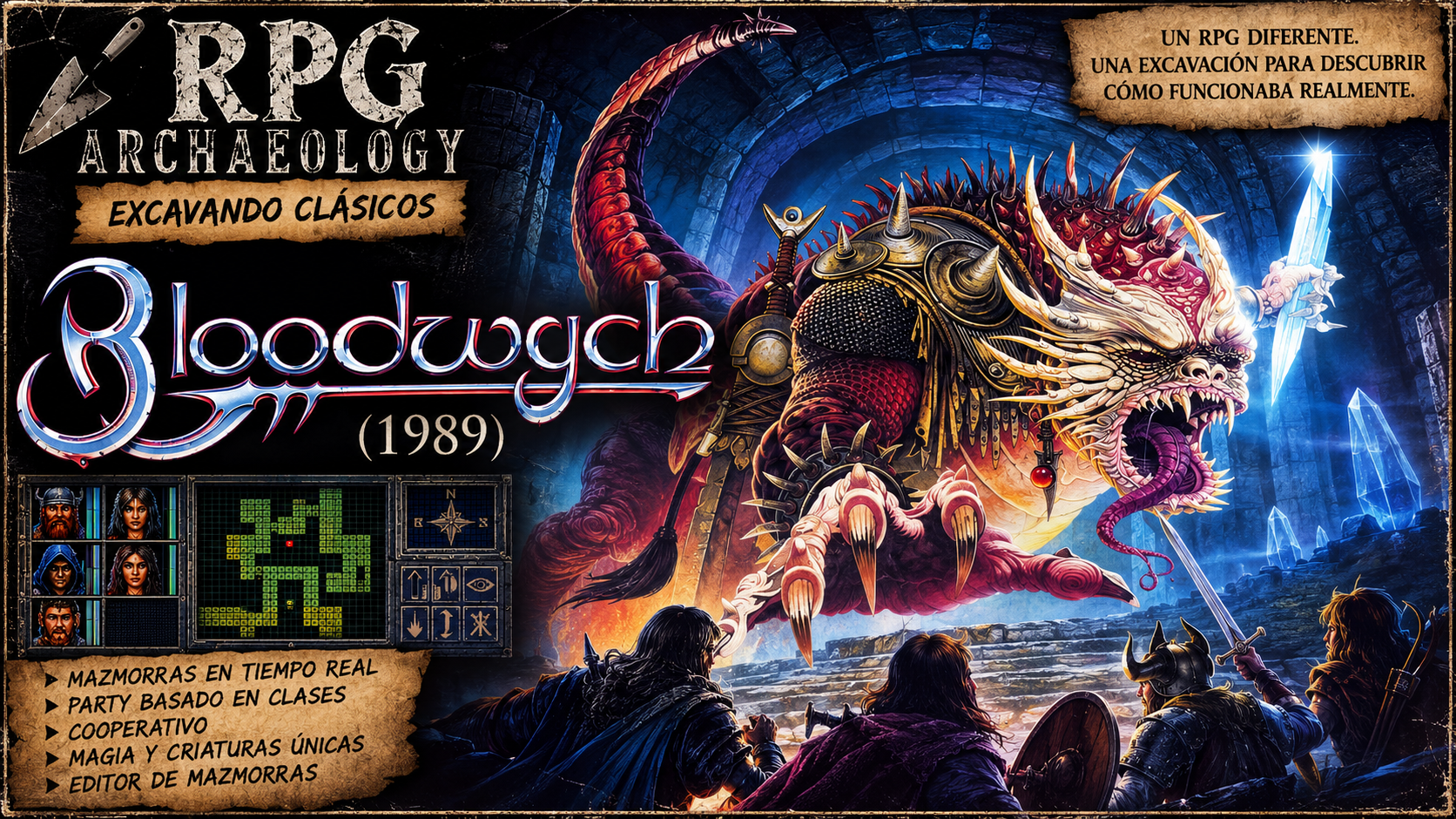
▶ Watch the episode on YouTube
Design, systems, and tooling archaeology report
Objective: Preserve a second reusable source of information for future design and architecture decisions in Lands of Folklore (LoF), especially in dungeon authoring, party, inventory, combat, magic, systemic interaction, multiplayer, and tooling.
This report does not aim to fully reconstruct the original code or document every aspect of the game. It focuses on verifiable design decisions and structures that may serve as a comparative reference.
1. Executive Summary
Bloodwych is particularly interesting for combining, already in 1989:
- first-person, real-time dungeon exploration;
- a party of individualized champions;
- simultaneous split-screen cooperative play;
- individual inventories and stats;
- tactical formation within a cell;
- conversation/trade via a compact interface;
- layered magic and progression;
- monsters physically present in the dungeon;
- a mutable world through switches and triggers;
- extremely compact spatial representation;
- an authoring model that, although not originally designed as a modern editor, was reconstructed by the community.
The main conclusion is that Bloodwych does not attempt to simulate a world through continuous physics. Its expressivity comes from: few discrete states + consistent rules + shared references + concrete actions on the dungeon.
This makes it especially useful as a reference for LoF, whose world also relies on grid, discrete states, and separation between editorial structure and runtime execution.
2. Primary Sources Consulted
Code / Resourcing
- Resourcing repository:
https://github.com/HoraceAndTheSpider/Bloodwych-68k- Reconstructed editor documentation:
docs/map-editor.md
docs/ui-layout.md
docs/dungeon-graphics.md
docs/resource-layouts.md- Reconstruction tools:
tools/map_editor/model.py
tools/map_editor/semantics.py
tools/monster_view.py
tools/champion_stats_scroll.py
tools/spellbook.py- Community AMOS editor archived in repo:
_archive/AMOS code/BloodwychEditor2-7_025.txt
_archive/AMOS code/BloodwychEditor2-7_026.txt
Community / Historical Documentation
- Ultimate Amiga:
Hacking / data structure guides
Bloodwych editor and modifications
source/disassembly notes- Lemon Amiga / Lemon64:
manuals and reviews- CRPG Addict:
design and gameplay analysis- Amiga Reviews:
contemporary and retrospective reviews
3. Confidence Status
For this report, three levels are used:
- CONFIRMED — backed by resourcing, reconstructed tools, or explicitly interpreted binary data.
- STRONG — consistent with multiple sources or observed behavior, but not yet traced to the specific routine.
- OPEN / UNKNOWN — interesting claim not yet closed with sufficient evidence.
PART 0 — THE HUMAN FACTOR AND PRODUCTION
3.1. The Authors: "Trazere's Trinity"
CONFIRMED
Bloodwych was not the product of a large studio, but the central effort of three individuals operating under strong technical and memory constraints.
- Anthony "Tag" Taglione (16-bit Programming and Design): Technical engine of the game. Wrote the engine in 68000 assembly for Amiga and Atari ST. His original motivation was to bring his tabletop Dungeons & Dragons games to computer to play with his friend Pete James. After seeing Dungeon Master, they decided the only way to surpass it was to build an engine capable of rendering two instances of the world simultaneously.
- Pete James (Art and Level Design): University friend of Anthony. Responsible for extreme visual optimization. Designed a tileset modular and lightweight enough for the engine to draw two first-person views without collapsing the RAM of machines at the time.
- Philip Taglione (8-bit Programming): Anthony's younger brother. Faced with the publisher's demand to launch the game on lesser systems, he rewrote and adapted all logic and architecture to Z80 assembly (ZX Spectrum, Amstrad CPC).
Conceptual Lesson
The architecture of Bloodwych (ultra-compressed data, discrete cell types) was not a theoretical whim, but a direct response to the need to maintain two player states and two simultaneous renders on machines with 512KB of RAM.
3.2. Production Lesson A: Loss of Runtime Control
CONFIRMED
The core team internally developed versions for Amiga, Atari ST, Spectrum, Amstrad, and Commodore 64. However, the publisher outsourced the MS-DOS (PC) port to an external studio called Walking Circles. The result was a technical disaster: the PC version launched with critical bugs that corrupted saves, broke switches, and made the game literally impossible to complete.
Principle Extracted for LoF
Runtime is sacred. Core logic cannot be delegated without absolute oversight.
If LoF ever requires ports or integrations with external systems (APIs, platforms, consoles), the original team must audit the state logic. Delegating engine responsibility without clear architectural contracts destroys the player experience, regardless of how good the level design is.
3.3. Production Lesson B: Flexible but Verified Scope
STRONG
The game cover was commissioned to illustrator Chris Achilleos with full creative freedom. Achilleos delivered a painting featuring a massive crystal demon. The team liked the art so much that, instead of ignoring it, they returned to the code and adapted the final game design to include that exact creature as the final boss: The Lord of Entropy.
Principle Extracted for LoF
Controlled asset permeability.
Although the general rule in LoF is "I don't expand scope without permission," the design must be modular enough that, if an exceptional asset emerges (a 3D model, a musical piece, concept art), the Data Model allows integration (creating a new Monster Record or Event Trigger) without rewriting the codebase. The engine consumes data; if the data is good, the engine must be able to absorb it without friction.
PART I — THE DUNGEON AS DATA MODEL
4. Map Resource Per Tower
CONFIRMED
Each Bloodwych tower has a fixed resource of:
- 0x1000 bytes per tower map;
- 0x38-byte header;
- up to 8 floors;
- the remainder (0xFC8) contains cells.
Each location occupies exactly:
2 bytes
The header stores, among other things:
- 8 widths;
- 8 heights;
- 8 data offsets;
- 8 X alignment offsets;
- 8 Y alignment offsets;
- special floor information;
- upper floor number.
This allows different floors to:
- have different dimensions;
- be offset relative to each other;
- relate vertically without needing a continuous 3D representation.
Lesson
A multi-level dungeon does not need to be a complete 3D volume. It can be:
Floor 0 -> grid 2D + alignment
Floor 1 -> grid 2D + alignment
Floor 2 -> grid 2D + alignment
...
and vertical connections are resolved through the relationship between grids.
5. Anatomy of a Cell
CONFIRMED
The two bytes of each cell are exposed in the editor as four nibbles:
Byte 0 A = bits 7..4 B = bits 3..0
Byte 1 C = bits 7..4 D = bits 3..0
The three lowest bits determine:
map_type = second_byte & 0x07
Therefore there are exactly 8 fundamental cell types. The semantics of remaining bits depend on the type. This is equivalent to an extremely compact variant/union.
PART II — THE 8 CELL TYPES
6. Type 0 — Space
CONFIRMED
Represents free/transitable space. Default semantics:
00 00
Its main function is to establish that a dungeon position can exist without containing any special structure.
Conceptual Reading
EMPTY / WALKABLE SPACE
7. Type 1 — Stone Wall + Feature
CONFIRMED
Does not represent only a stone wall. It can store:
- side/orientation;
- special state;
- one of several wall feature types.
Documented families:
SHELF SIGN SWITCH SOCKET
Switches can have:
- reference;
- visual state (LIT / DIM).
Sockets can have:
- gem family;
- state FULL / EMPTY.
Signs can represent:
- thematic signs;
- scrolls/references.
There is also an occlusion/hiding state.
Conceptual Reading
STRUCTURAL MASS
+
WALL-MOUNTED FEATURE
Comparison with LoF
Bloodwych compresses within the cell what LoF tends to separate conceptually as:
StructuralEdge
+
Placed / Interactive Feature
8. Type 2 — Wooden Structure
CONFIRMED
A single cell can independently represent the four sides:
N E S W
Each side uses two bits and accepts:
NONE WALL OPEN CLOSED
Additionally, a lock state can exist. Conceptual example:
N = WALL E = OPEN S = NONE W = CLOSED
Conceptual Reading
It is an ultra-compressed form of:
Cell
Edge N
Edge E
Edge S
Edge W
Relevance for LoF
It's a historical direct reference to the same problem LoF solves via StructuralEdge.
Bloodwych integrates edges into the cell out of compression necessity. LoF extracts them as explicit editorial entities for clarity and extensibility.
9. Type 3 — Misc Solid
CONFIRMED
Groups at least:
BED PILLAR
This classification may seem strange from a modern ontology, but likely reflects a functional decision: both are special elements occupying the cell and processed similarly by the engine.
Archaeological Lesson
Historical data categories don't always describe "what something is" in the world. Often they describe: what engine routine needs to process it.
10. Type 4 — Stairs
CONFIRMED
Encodes:
Elevation: UP / DOWN Direction: N / E / S / W
It doesn't need to store a complete destination in the cell itself. Vertical relationships depend on the floor's layout/alignment.
Conceptual Reading
VERTICAL CONNECTION
11. Type 5 — Metal Door
CONFIRMED
Metal doors are their own category. Can define:
REGULAR / PORTCULLIS NORTH-SOUTH / EAST-WEST OPEN / CLOSED LOCK TYPE
Documented lock families by reconstructed editor:
UNLOCKED MAGE BRONZE IRON SERPENT CHAOS DRAGON MOON CHROMATIC VOID
Design Lesson
A lock doesn't necessarily represent requires_key = true. It can be a connection point with other systems: progression, magic, faction, school, object, global state.
Comparison with LoF
Bloodwych: Door = Cell Type
LoF: Door = StructuralEdge(kind = DOOR)
12. Type 6 — Floor / Event Surface
CONFIRMED
Can represent:
FIZZLE FLOOR HOLE GREEN PAD INVISIBLE PAD
Additionally, independently:
CEILING HOLE NO CEILING HOLE
Pads can contain a reference to a trigger table. Example:
Cell: invisible pad trigger_ref = 17 ceiling_hole = true
Conceptual Reading
FLOOR / SURFACE STATE
+
EVENT REFERENCE
Relevance for LoF
Clear example of reactive world without continuous physics. A cell can have discrete states and references to behavior.
13. Type 7 — Magic Space
CONFIRMED
Documented states:
SPACE FIREPATH MINDROCK FORMWALL
More:
POWER = 0..63
Design Lesson
Certain magical effects are modeled as space properties, not necessarily as separate actors.
Relevant for future LoF ideas like: burning, flooded, frozen, poisoned, corrupted, anti_magic, smoke.
The key point isn't to copy the model, but to remember that: a cell's state can be an active part of the simulation.
PART III — THE SPATIAL VOCABULARY
14. Abstract Classification
If we strip the specific game names, the 8 types roughly represent:
0 EMPTY SPACE
1 STRUCTURAL MASS + FEATURE
2 PER-SIDE STRUCTURE
3 CELL OCCUPANT / SOLID FEATURE
4 VERTICAL CONNECTION
5 PASSAGE BARRIER
6 FLOOR / EVENT SURFACE
7 ENVIRONMENTAL / MAGIC STATE
This abstraction is more important than the specific names. Bloodwych had to answer, under extreme constraint: "What are the fundamental ways a dungeon position can participate in the game?"
The 3-bit limit forced definition of a very small, very explicit spatial vocabulary.
Possible Future Exercise for LoF
Without imposing an eight type limit: What are the fundamental responsibilities of StructuralCell, StructuralEdge, and PlacedInstance?
Not to create huge enums, but to detect responsibility mixing.
PART IV — SWITCHES
15. Switch Structure
CONFIRMED
A Type 1 cell can contain a switch. The cell doesn't store its behavior directly. It stores a reference to a shared definition.
STONE WALL CELL | +-- SWITCH | +-- reference | v SwitchRecord ------------ action target X target Y
Each tower has:
16 switch definitions 4 bytes each
16. Switch Actions
CONFIRMED
The reconstructed editor identifies these actions:
0x00 NO EFFECT 0x02 REMOVE 0x04 TOGGLE WALL 0x06 OPEN METAL DOOR 0x08 ROTATE WALL 0x0A TOGGLE PILLAR 0x0C PLACE PILLAR 0x0E ROTATE WOODEN WALL
There's no general scripting language. There's a reduced vocabulary of known verbs operating on the world.
17. Conceptual Interaction Model
ACTIVATOR
|
v
REFERENCE
|
v
ACTION + TARGET
|
v
WORLD STATE TRANSITION
Example:
Switch #3
action = OPEN METAL DOOR
target = (14,8)
18. Dungeon Verbs
The switch language reduces to: OPEN, REMOVE, TOGGLE, ROTATE, PLACE.
This simplicity allows building remote doors, secret walls, moving pillars, rotating mechanisms, connectivity changes, spatial puzzles.
Main Lesson
Before introducing general scripting: check how much dungeon can be built with a small set of Commands on known states. Especially relevant for LoF, which already uses Commands in its editorial architecture.
19. Reference Reuse
CONFIRMED
Multiple cells can share the same SwitchRecord.
Switch A -\ Switch B -----> SwitchRecord #7 Switch C -_/
Lesson for LoF
When an Inspector modifies a shared resource: the UI must communicate that the modification affects more than one instance. Applicable to materials, interaction profiles, actor definitions, shared behaviours, reusable resources, event definitions.
PART V — TRIGGERS
20. Conceptual Difference Between Switch and Trigger
CONFIRMED
Switch:
action x y
Trigger:
action floor x y
The switch works as a relatively local spatial mechanism. The trigger is a more general event tool and can explicitly affect another floor.
21. Known Trigger Actions
The resourcing documents a much wider vocabulary:
NO EVENT, SPINNER 1, SPINNER 2, OPEN METAL DOOR, VIVIFY, WOOD DOOR TRAP, TRADER DOOR, TOWER ENTRANCE, REMOVE, CLOSE METAL DOOR, TOGGLE PILLAR, CREATE PAD, CREATE WALL... (among others)
Conceptual Reading
Triggers cross the border between MECHANISM and EVENT SYSTEM. They allow modifying geometry, moving/creating elements, teleporting, changing data, entering towers, special conditions, etc.
PART VI — PARTY AND CHAMPIONS
22. Party as Operational Container
CONFIRMED in general structure.
Bloodwych doesn't destroy champion individuality. Each champion maintains identity, profession, stats, HP, Vitality, Spell Points, spells, inventory, equipment, position, orientation, states.
But the player operates them from a common party layer.
PLAYER --> PARTY --> [CHAMPION, CHAMPION, ...]
23. Subpositions Within a Cell
CONFIRMED
There are five subpositions: 0 near right, 1 near left, 2 rear left, 3 rear right, 4 centre
Lesson
A grid-based system can have tactical micro-space without abandoning the grid.
24. Champion Record
CONFIRMED in already reconstructed fields Clear separation of Level, Attributes, Resource Pools, Knowledge, Equipment, Position. Not everything reduces to "class + level".
PART VII — INVENTORY
25. Individual Inventory
CONFIRMED
Each champion maintains its own inventory (12 visible slots).
Party control = shared operational layer Inventory = individual ownership
26. Derived Stats
CONFIRMED
Final protection combines base value + equipment + states + hand armor + shield.
Lesson for LoF
Prefer, when it makes sense, derived stats from explicit sources over storing the same final result in multiple places.
PART VIII — MAGIC AND PROGRESSION
27-30. Magic and Level-up
CONFIRMED
The 32 spells are represented via individual flags. Knowledge is stored per individual. There's also a separate runtime spell practice matrix. The level's contribution to casting varies by profession. The same Level is mechanically interpreted differently depending on the character.
PART IX — COMMUNICATION AND AGENCY
31. Real-time Communication
STRONG
Bloodwych integrates communication, trade, and interaction within the same game interface (trade, threaten, bribe, praise, etc.). It's compact and compatible with real-time play.
32. Companion Agency
STRONG
Social interactions influence companion autonomy. A companion could maintain a small set of tendencies (loyalty, confidence, aggression) as modifiers for micro-decisions.
PART X — MULTIPLAYER
33. Multiplayer as Structural Requirement
CONFIRMED at design level Bloodwych supports two simultaneous players. Each side maintains its own player state and independent UI region.
34. What This Does NOT Mean for LoF
The reasonable policy for LoF is single-player product, but avoid gratuitous assumptions that make multiple players impossible. Networking, if it ever exists, must be considered post-development.
PART XI — THE COMMUNITY EDITOR
35. Not Just a Map Editor
CONFIRMED
The community AMOS editor was able to handle references and data for towers, switches, monsters, stats, etc. Classic example of scope creep in tooling.
36. Modern Editor Modes
Different world responsibilities need different authoring modes. Not everything should be edited through the same panel or tool.
37. Raw View + Semantic View
An advanced tool can offer semantic authoring + raw diagnostics without forcing the user to constantly work at the binary level.
38. Valid Defaults When Changing Type
An editorial transformation should produce a valid state by construction rather than accumulating invisible semantic residue. Particularly relevant for Inspectors in LoF.
39. Original vs Modified
The modern editor never overwrites the clean resource. Clearly separate: source, working state, generated/modified output.
40. Dirty Resources
The editor tracks dirty towers/resources. Only modified ones are written.
41. Editorial Overlays
Switches and triggers can be displayed as overlays. The idea for LoF is: multiple lenses over the same editorial document.
42. First-person Preview
The authoring preview doesn't respect game collision rules, because authoring navigation and runtime navigation are distinct responsibilities.
PART XII — PRINCIPLES EXTRACTED FOR LOF
43. Discrete State as Alternative to Physics
A dungeon can be systemic without being a continuous physics immersive sim. Philosophy for LoF: Systemic dungeon crawler.
44. Problem, Not Mandatory Solution
A class or ability shouldn't necessarily be a single key (e.g., LOCKED DOOR can be opened with lockpick, break, spell, key).
45. Small Vocabulary Before Scripting
Evaluate how much content can be expressed through semantic Commands and well-defined states before introducing general scripting.
46. Reference vs Instance
The PLACEMENT -> REFERENCE -> SHARED DEFINITION pattern is very useful, but requires explicit UX when modifying the shared resource.
47. Party as Operational Unit Without Erasing Individuals
Combine group-level control with individual character state.
48. Grid + Subpositions
Architectural option: world movement = grid, local tactical occupancy = sub-grid / slots.
49. Authoring Navigation != Runtime Navigation
A preview must declare what it intends to validate. There's no single correct definition of "preview".
50. Editor as Collection of Lenses
The same document may need different views depending on the author's question (Structure View, Navigation View, Interaction View, etc.).
PART XIII — OPEN ITEMS
51. Open Questions
Combat, AI, Progression, Social. Design return decreased. These remain as OPEN / OPTIONAL FUTURE EXCAVATION.
PART XIV — CONCLUSION
52. What Bloodwych Represents Within RPG Archaeology
Conceptual formula:
SMALL DATA MODEL
+
CLEAR STATE
+
REUSABLE REFERENCES
+
WORLD COMMANDS
+
CONSISTENT RULES
=
SYSTEMIC DUNGEON
PART XV — FUTURE USE IN LOF
53. How to Reuse This Report
Retrieve as comparative context for future features. Recommended prompt: "Take a look at the Bloodwych report from RPG Archaeology and refresh context. Compare the documented decisions there with LoF's current cut/feature. Don't propose changes by automatic analogy: identify only useful patterns, risks, alternatives, and structural differences."
54. Methodological Reminder
The function of RPG Archaeology is not to copy old solutions, but to discover what problems have already been solved, under what constraints, at what cost, and which principles survived.
STATUS: Bloodwych excavation — CLOSED
Possible future revisit: only for targeted questions with clear value.
Next comparative target: Forgotten Realms: Unlimited Adventures.