Ultima Underworld: The Stygian Abyss (1992)
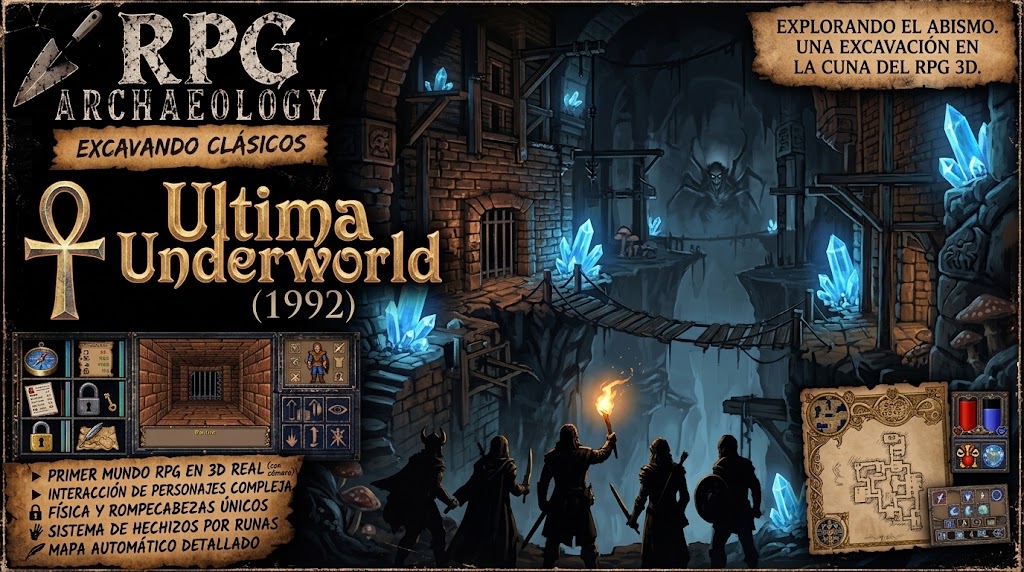
The dungeon as place, system, and space of possibilities
Developer: Blue Sky Productions
Publisher: Origin Systems
Reference platform: MS-DOS
Year: 1992
Object of study: spatial design, exploration, systems, environmental/social narrative, information, progression, and the cost of the fantasy.
1. Archaeological question
Ultima Underworld is usually remembered for its technology: first-person perspective, continuous movement, textures, elevations, slopes, and an extraordinarily advanced three-dimensional space for 1992.
But reducing it to a graphical revolution leaves out much of what is interesting.
The question of this report is different:
How did Ultima Underworld make a dungeon stop feeling like a succession of tiles, rooms, and encounters and start feeling like a place where the player was living an adventure?
And, for Lands of Folklore:
Which principles can be preserved without reproducing the scale of simulation, the specific solutions, or the frictions of Underworld?
2. Context: before the language existed
DOCUMENTED FACT
Ultima Underworld appeared in March 1992, before Wolfenstein 3D and later Doom consolidated much of the vocabulary of control and representation that we would come to associate with the first-person game.
A contemporary preview in Computer Gaming World highlighted precisely the difference with respect to dungeon crawlers such as Eye of the Beholder: fluid 360-degree movement instead of discrete displacement, describing the result more as a fantasy combat simulator than as a traditional CRPG. CGW Museum
Allen Greenberg's review, published by CGW a few months later, already pointed to the reverse: the mouse supported an enormous number of functions, and moving, holding a heading, controlling speed, and jumping between different elevations required coordination unusual in an RPG. CGW Museum
ARCHAEOLOGICAL READING
Underworld was inventing part of the idiom while writing the work.
Some of its frictions are not design principles that should be preserved. They are the historical cost of exploring a territory for which mature conventions did not yet exist.
3. The fundamental fantasy: "being down there"
The fundamental contribution of Underworld does not seem to lie in an isolated mechanic.
It comes from the accumulation:
movement + elevation + slopes + water + darkness + light + objects + inhabitants + resources + conversations + secrets + spatial continuity.
DOCUMENTED FACT
Paul Neurath has retrospectively described his interest in using the computer to create worlds in which the player could act with a freedom similar to what he experienced in his tabletop role-playing sessions. His emphasis when speaking about Underworld decades later is far more on the concepts of simulation and agency than on the feat of texture mapping. Game Developer
Dan Schmidt recalls an even more explicit ambition: the young team intended to build a convincing simulation of the dungeon in graphics, physics, AI, combat, and even conversation. He also acknowledges that some of those ambitions, such as conversation, ended up resorting to far more conventional solutions. The Ultima Codex
ARCHAEOLOGICAL READING
Underworld does not only sell the fantasy of:
"I am an RPG character."
Its distinctive achievement is to approach:
"I am an adventurer down here."
Space stops being merely support for stats and encounters and becomes part of the experience.
4. Space is gameplay
Underworld's spatial differences are not exclusively ornamental.
Elevations, slopes, water, pits, bridges, darkness, inaccessible areas, jumps, and connections between places change how the dungeon is traversed and understood.
The contemporary CGW review explicitly highlighted jumping chasms and reaching different elevations as skills needed to get around the game. CGW Museum
ARCHAEOLOGICAL READING
The revolution cannot be reduced to:
RPG + 3D
A more useful description would be:
RPG + PHYSICALLY LEGIBLE AND TRAVERSABLE SPACE
The terrain stops being background.
The terrain communicates and conditions possibilities.
LESSON FOR LoF
A grid does not prevent achieving this.
What matters is not that space is continuous, but that its differences have meaning.
A Cell can express:
- geometry;
- region;
- surface;
- elevation;
- state;
- danger;
- information;
- possibility of interaction.
The goal is not to hide that LoF uses Cells.
It is to get the player to end up seeing a dungeon before a grid.
5. Exploring does not only mean finding loot
One of the main findings of this autopsy was to broaden what we understand by exploration reward.
An exploration can provide:
- INFORMATION
- ROUTE
- PERSON
- RELATIONSHIP
- OBJECT
- MECHANISM
- HISTORY
- STATE
- DECISION
- POSSIBILITY
Therefore:
Exploration produces gameplay when it changes what the player knows, understands, or can attempt.
A new tunnel can be worth more than a sword.
A conversation can change the interpretation of a known place.
A seemingly useless piece can acquire meaning hours later.
A mechanism can transform an already visited area.
LESSON FOR LoF
A useful question when designing an area is not only:
"What content does this room contain?"
But also:
"What possibility can the player discover here?"
This does not imply that every room must hide something.
Transition, rest, and orientation spaces are also necessary.
The problem appears when the player crosses large amounts of space without ever changing their mental representation of the world.
6. The dungeon contains a society, not just a population of enemies
Underworld includes hostile creatures, but also communities, individuals, exchanges, conflicts, and inhabitants that do not exist solely to be eliminated.
The result is fundamental to the perception of the Abyss as a place.
The story of Sir Cabirus's colony also provides a historical substrate: the player does not simply enter a dungeon built to receive them; they enter the remains of a social project that had a prior history.
ARCHAEOLOGICAL READING
The inhabitants help answer an essential question:
"Why does this place exist when I am not here?"
A room with hostile goblins is an encounter.
An area occupied by groups with relationships, problems, and history starts to feel like territory.
7. Stories that belong to the world
Underworld has an explicit plot: Garamon, Arial, Tyball, and the danger associated with the Slasher of Veils.
But around it there is another layer formed by the history of Cabirus, its talismans, current inhabitants, relationships, scattered objects, and local conflicts.
Dan Schmidt explains that, when they began building the eight levels, the macrostructure — talismans, key parts, and plot obligations — was already established. Each designer knew what their level had to contribute, but then had considerable local freedom. Schmidt ultimately took charge of connecting and homogenizing the whole. The Ultima Codex
That suggests an especially interesting model:
MACROSTRUCTURE
      ↓
AREA CONTRACT
      ↓
LOCAL DESIGN FREEDOM
Not everything local needs to exist exclusively to push the main plot forward.
8. Local problems, distant consequences
The structure of several talismans shows connections that cross levels and characters.
For example, the Sword of Justice requires finding parts in different places and returning to Shak to repair it. The Ring of Humility links a Gazer, a reward, and later information provided by Derek. Freeing Murgo ends up providing information related to the Wine of Compassion. Community documentation preserves these acquisition chains. Sir Cabirus
Not all situations in Underworld work this way, and we should not romanticize the game: conventional errand-and-reward structures also exist.
But the pattern appears often enough to be interesting:
PERSON
   ↓
PROBLEM / DISCOVERY
   ↓
OBJECT / INFORMATION
   ↓
ANOTHER PLACE
   ↓
ANOTHER PERSON
   ↓
CONSEQUENCE
ARCHAEOLOGICAL READING
A story does not need to be presented initially as a complete quest.
It can emerge from relationships between things the player discovers separately.
LESSON FOR LoF
The world provides stories; the player discovers them.
That does not eliminate authored narrative.
It changes how part of that narrative reaches the player.
9. Backtracking as reinterpretation
Returning to a known place is not necessarily repeated content.
It can be progress if the player returns with:
- new information;
- another object;
- a new relationship;
- a change of state;
- knowledge of a rule;
- a new interpretation of space.
The Sword of Justice is a simple example: spatially distributed components acquire meaning when the player understands their relationship and remembers someone capable of repairing them. Sir Cabirus
ARCHAEOLOGICAL READING
Good backtracking roughly follows:
INVESTIGATE
   → DISCOVER
   → LEARN / OBTAIN
   → REINTERPRET
   → RETURN
   → NEW POSSIBILITY
Not:
FIND BLUE KEY
   → WALK EIGHT MINUTES
   → OPEN BLUE DOOR
Shortcuts and new connections also have an important cognitive function: they progressively compress a space the player already knows.
10. Knowledge is progression
Underworld does not progress exclusively through stats, experience, and equipment.
The player accumulates knowledge about people, relationships, places, properties, objects, mechanisms, and routes.
This leads to a form of progression that RPG Archaeology had already encountered, in another form, in The Dark Heart of Uukrul: understanding the rules can also be progressing.
In Underworld the pattern can be expressed as:
OBSERVE
   → TEST
   → RESULT
   → LEARN
   → GENERALIZE
When this works, the player stops asking only:
"What does the game want me to do?"
and starts asking:
"Will what I learned there work here?"
That is where systemic play appears.
11. A small grammar of interaction
To analyze this type of design, it is useful:
VERB → OBJECT → PROPERTY → STATE → CONSEQUENCE → INFORMATION
What matters is not necessarily multiplying verbs.
It is getting the existing ones to act on properties consistent enough that the player can build a mental model.
LESSON FOR LoF
LoF does not intend to become a universal simulation, nor does it need to pursue the immersive sim label.
The interesting transfer is:
build a bounded, coherent, and discoverable set of basic RPG mechanics that can be recombined in numerous situations.
We do not want the player to think:
"I can do anything."
We want them to learn:
"I know what things this world allows, and I just thought of trying one."
12. Information: the interface remembers, the player deduces
Underworld's automap updates as you explore and lets the player write their own annotations directly. The manual expressly teaches this feature. Abandonware DOS
This has an important design consequence.
There is a difference between:
externalizing memory
and
externalizing reasoning.
A modern system can remember:
Shak — blacksmith.
Flooded gallery.
Unknown mechanism.
Symbol seen in the crypt.
without automatically transforming those observations into:
QUEST: REFORGE THE SWORD
☑ Find blade
☐ Find hilt
☐ Return to Shak
📍 TRACK
LESSON FOR LoF
The interface remembers; the player deduces.
The player should not need to remember what they did two Tuesdays ago after work.
But we also do not need to resolve for them the relationships between the information we have preserved.
That allows reducing friction without reducing intellectual responsibility.
13. Light, food, and corporeality
The manual itself uses the torch very early on to teach the player how the world's visibility changes and later warns of the need to have food. ManualMachine
DOCUMENTED FACT
Food has its own nutrition values and exists as a systemic resource. Reconstructed tables of the game show different values for meats, breads, fish, corn, popcorn, mushrooms, and other foods. Ultima Codex
However, it is worth correcting an easy simplification: in Ultima Underworld, hunger does not work exactly like a modern survival bar whose fall quickly leads to death. Among its effects is impairing recovery when resting; literally dying of starvation is difficult in a normal playthrough. Ultima Codex
NOT DEMONSTRATED
We have not found sufficient evidence to affirm that contemporary players specifically considered the hunger system tedious or unpleasant.
ARCHAEOLOGICAL READING
The interest for LoF is not copying hunger.
It is distinguishing:
RESOURCE → MAINTENANCE
from:
RESOURCE → DECISION
A resource deserves special attention when it keeps producing decisions after the player understands how it works.
That is why for LoF it is potentially more interesting:
INGREDIENT → PREPARATION → EFFECT
than:
HUNGER -1 → EAT BREAD → HUNGER +10
And with light:
SOURCE → PROPERTIES → DURATION / RANGE / INTENSITY → DECISION
without needing to decide now on future stealth or perception systems.
14. Combat: spatial continuity in exchange for friction
Underworld keeps combat within the same continuous space as exploration.
There is no transition to a separate board or subsystem.
That preserves physical presence.
But it also forces movement, orientation, action selection, and combat to share a still-experimental interface.
CONTEMPORARY EVIDENCE
The CGW preview described combat favorably as fluid. CGW Museum
A few months later, Allen Greenberg's review highlighted the considerable coordination demands and the functional overload of the mouse. CGW Museum
CONCLUSION
There is no basis for writing:
"Combat in Underworld was bad."
Nor:
"Real-time combat was a superior evolution of turn-based RPG."
The evidence shows different perceptions.
The correct archaeological question is:
What does Underworld gain by making combat real-time within the space, and what does it pay for it?
LESSON FOR LoF
REAL TIME ≠ EVOLUTION
TURN BASED ≠ PRIMITIVE HERITAGE
The combat model should be judged by the experience it produces and the problems it solves.
15. Cost of the fantasy
Underworld wanted the player to believe they were physically inside the Abyss.
That had a price.
Interface and control
The game needed three-dimensional movement, inventory, conversation, manipulation, magic, combat, look, use, and pick up before consolidated conventions existed for integrating all of it.
Contemporary press already detected this friction. CGW compared some of the required coordination skills to those of driving or flight simulators. CGW Museum
Hardware
Continuous space, textured surfaces, elevations, creatures, objects, and lighting demanded a considerable computational budget for a 1992 PC.
The result also included visible compromises such as a relatively small viewport and an interface that occupied a significant fraction of the screen.
Systemic complexity
Dan Schmidt recalls that they intended to simulate practically every aspect of the dungeon and acknowledges that some ambitions, especially conversation, did not find a solution equivalent to the initial aspiration. The Ultima Codex
ARCHAEOLOGICAL READING
Underworld paid for its fantasy through:
HARDWARE + INTERFACE + LEARNING + SYSTEMIC COMPLEXITY
Not all of those costs belong to the essence of what made the game interesting.
LESSON FOR LoF
We can preserve:
cognitive demand
without preserving:
operational friction.
We can preserve:
exploration
without preserving:
uncomfortable controls.
We can preserve:
deduction
without preserving:
unnecessary memory load.
We can preserve:
related systems
without building:
a universal simulation.
16. Reception and commercial success
Here it is especially important to avoid the myth of the "masterpiece nobody bought."
DOCUMENTED FACT
A snapshot of Origin's internal newsletter dated July 31, 1992, showed approximately 41,000 copies shipped of Underworld, versus about 71,000 of Ultima VII. Filfre
Sales continued to grow afterward. Jimmy Maher's historical reconstruction attributes that behavior to extraordinarily favorable reviews and strong word of mouth; he also records Paul Neurath's later claim that the game eventually surpassed half a million copies worldwide. That last figure must be kept as a retrospective claim by Neurath, not as independently verified accounting. Filfre
Contemporary critical reception was very strong. Computer Gaming World recognized it as RPG of the Year and it later entered its Hall of Fame; it also received the Origins Award for best fantasy or science fiction computer game of 1992. MobyGames
CONCLUSION
Not:
"Underworld sold poorly."
Nor:
"It was an instant bestseller."
The formulation that best fits the available evidence is:
Underworld began with relatively moderate sales compared to Ultima VII, but developed a long commercial trajectory supported by exceptional critical reception and word of mouth, also becoming a title of enormous historical prestige.
CONTEXT
It must be interpreted within the PC and RPG market of the early nineties, incomparably smaller than today's market.
We do not have sufficient evidence to directly attribute its initial commercial pace to the social stigmatization of video games, although this forms part of the broader cultural context of the era and would increase notably during the following years.
17. Underworld does not prove that "more simulation = better RPG"
That would be a mistaken reading of the entire excavation.
Its interesting legacy does not consist of:
hunger + physics + NPC + conversation + crafting + first person + real time = good game.
Schmidt's own testimony demonstrates that the ambition of simulation could exceed what was actually possible to implement satisfactorily. The Ultima Codex
ARCHAEOLOGICAL READING
The power appears when enough elements of the game form a coherent language.
Therefore:
consistency > quantity of systems
But this also should not be transformed into an artificial rule like "LoF can only have ten systems."
LoF needs the systems proper to its RPG.
The question is to ensure they do not live in watertight compartments.
18. What LoF preserves
We do not copy features.
We preserve questions and principles.
| Underworld | Transferable principle | LoF |
|---|---|---|
| Continuous 3D space | Space must have meaning | Grid with spatial semantics |
| Light/darkness | The environment can be resource and state | Light sources with properties |
| Inhabitants/factions | The dungeon can have a society | NPCs and bounded relationships |
| Distributed objects | Knowledge connects places | Related stories/objects |
| Annotatable automap | Externalize memory | Map/journal that remembers |
| Free exploration | Discover possibilities | Routes, information, states, interaction |
| Backtracking | Reinterpret known space | New states/knowledge/connections |
| Broad simulation | Rules can be combined | Bounded box of coherent mechanics |
| Bodily resources | Resources can produce decisions | Avoid maintenance without gameplay |
| Freedom | Formulate your own solutions | Freedom within LoF's language |
19. What we do NOT inherit
There is no obligation to copy:
- periodic hunger;
- real-time combat;
- 1992 multimodal interface;
- continuous movement;
- universal physics simulation;
- systemic conversations;
- all manipulable objects;
- all survival systems;
- the exact narrative structure;
- the scale of simulation;
- the immersive sim label.
The goal is not to build Ultima Underworld III.
Neurath can take care of the brown. 😄
20. LoF seed: Search / Rummage
This idea does not historically come from Underworld. It arises during this autopsy when asking ourselves how to make even LoF's minimum spatial unit occasionally invite curiosity.
DESIGN SEED — NOT AN ADR
A Cell could optionally admit:
UNSEARCHED → SEARCH → SEARCHED
With two possible sources of result:
DEFAULT → contextual profile → RNG low-tier
or:
AUTHORED → predetermined result
The systemic result can be small: nothing, a few coins, common supplies, an ingredient, common ammunition, cheap curiosity, or a small risk.
The authored result can use the same verb to exceptionally produce a specific object, information, discovery, or change of state.
The player does not need to know which of the two mechanisms responded.
PRINCIPLE
The general system creates an expectation; authorship can take advantage of it.
RISK
A per-Cell search could easily degenerate into compulsive behavior:
"I have to rummage through all 16 Cells in this room."
Therefore, it only merits a prototype.
The validation question will be:
Does searching make the player pay more attention to the dungeon, or does it make them want to mark every Cell as completed?
21. Questions Underworld leaves open for LoF
These questions deserve to survive the report:
Can a rule learned in one place be applied spontaneously in another?
Does exploration change the player's possibilities, or does it only fill their inventory?
Does a resource generate decisions or maintenance?
Does backtracking allow reinterpreting a known place?
Does the interface remember without resolving?
Do the inhabitants seem to belong to the dungeon, or do they wait for the player to deliver content?
Do the stories seem to exist in the world, or only in the quest log?
Can a Cell represent a possibility in addition to geometry?
How much additional play can we get from the RPG mechanics that already exist before needing a new one?
22. Archaeological synthesis
ARCHAEOLOGICAL READING
The great lesson of Ultima Underworld is not that an RPG needs more simulation. It is that a world becomes convincing when the player learns that its spaces, inhabitants, objects, and rules deserve attention because they can contain possibilities.
Underworld pursued that feeling through an extraordinarily ambitious simulation for 1992.
LoF can pursue the principle through another strategy:
a bounded, consistent, and discoverable set of RPG mechanics that produces more situations than systems.
We do not want the player to think:
"I can do anything."
We want them, after learning the game's language, to look at a situation and think:
"Wait... I could try something here."
If that happens, the dungeon is no longer simply geometry connecting encounters.
It has become a place that deserves to be investigated.
Primary Sources
The most important contemporary basis for this report is the review in Computer Gaming World, no. 96 (July 1992), especially useful for controls, movement, coordination, elevations, and immediate reception. Computer Gaming World no. 96 — CGW Museum
For design intent and production reconstruction, the interview with Dan Schmidt provides direct evidence on the ambition of simulation, conversation, level construction, and plot macrostructure. Interview with Dan Schmidt — Ultima Codex
The retrospective interview with Paul Neurath is useful for his design goals and his later reading of Underworld, always treating it as testimony thirty years after development. Paul Neurath on Ultima Underworld — Game Developer
For the commercial trajectory, The Digital Antiquarian reproduces data from Origin's internal newsletter and distinguishes the contemporary figures from Neurath's retrospective claims. Life Off the Grid: Making Ultima Underworld — The Digital Antiquarian
The Player's Guide constitutes primary evidence for the functioning of light, food, and automap/annotations. Ultima Underworld Player's Guide — preserved transcription
For relationships between talismans, characters, and levels we have used community reconstruction; it is evidence of the game's behavior/structure, not contemporary documentation of design intent. Sir Cabirus — Ultima Underworld Talismans
Status
ULTIMA UNDERWORLD: THE STYGIAN ABYSS — AUTOPSY CLOSED 🔨⚰️